
Analysts predict that developments in US-Iran negotiations, fluctuations in crude oil prices, and key global economic data will be the primary drivers of gold and silver prices in the coming week, with a strong focus on talks in Switzerland.

After years of rapid expansion, the Centre's capital spending growth eases as private investment shows early signs of revival, points out A K Bhattacharya.

A parliamentary committee has voiced concerns over ongoing examination irregularities despite government measures, recommending the Ministry of Education publish a time-bound roadmap for reforms. The panel also urged a nationwide blacklist of firms involved in exam processes and suggested utilising the National Testing Agency's financial surplus to enhance its capabilities.

Private hospitals accounted for 30.8 per cent of current health expenditure in FY23, while pharmaceuticals and medical goods contributed more than 21 per cent, underlining continued dependence on private healthcare and medicine spending.

India's economy in FY26 saw significant momentum from investment demand, with gross fixed capital formation (GFCF) accelerating to 8.2 per cent, while private final consumption expenditure (PFCE) also grew steadily, according to provisional estimates.

The ongoing investigation into the murder of Pune realtor Ketan Agarwal suggests that his fiance, Siya Goyal, was instigated by co-accused Chetan Chaudhary to commit the crime. Goyal and Chaudhary, who were in a relationship, are accused of pushing Agarwal off Lohagad Fort. The probe also addresses reports about Agarwal wearing a wig and details about the planned wedding expenses.

Chief Economic Advisor V Anantha Nageswaran stated that India's economy is projected to return to a 7 per cent-plus growth trajectory by 2027-28 (FY28), or sooner if external conditions improve, despite near-term challenges from the West Asia crisis.

The Comptroller and Auditor General of India (CAG) has reported significant financial irregularities in the Union government's FY25 accounts, including ~12,754.47 crore in misclassification and ~54,282.32 crore in outstanding utilisation certificates, with some dating back to 1985-86.

Shareholder payouts by India Inc, including dividends and buybacks, increased by 2.2 per cent year-on-year in FY26 to $5.06 trillion, but this growth lagged the 18.8 per cent rise in reported net profit for the third consecutive year, leading to the lowest dividend payout ratio in 12 years.

India's defence expenditure surged to $92.1 billion in 2025, making it the world's fifth-largest military spender, according to SIPRI data. This 8.9 per cent year-on-year rise was primarily driven by operational and procurement needs following heightened regional tensions with Pakistan in May 2025.
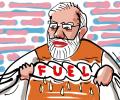
Following through announcements with enforcement of measures is key, as a run through recent Indian economic history shows, points out A K Bhattacharya.

Overseas travel spending by Indians, including holiday trips, decreased by $212.43 million to $1.09 billion in March compared to February, according to the Reserve Bank of India's latest data.

The Indian government is set to accelerate reforms, including measures to enhance foreign direct investment, speed up divestment, and boost asset monetisation, to maintain economic growth despite rising fuel and fertiliser import costs driven by the West Asia crisis.

While India's interplanetary ambitions remain significant, the current pace of financial and technical progress raises questions about whether the 2027-2028 timelines can be met.
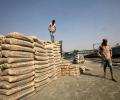
Indian cement manufacturers, despite a stable Q4FY26, are bracing for significant profitability pressures from Q1FY27 onwards due to escalating input costs, primarily driven by the West Asia conflict's impact on coal and petcoke prices.

Kerala, Tamil Nadu and West Bengal have been fiscally stressed for a considerable period of time, and there are no easy ways to mobilise revenues to meet the cost of the promised freebies, particularly in the prevailing difficult economic scenario, points out M Govinda Rao.

The global artificial intelligence (AI) boom has significantly reshaped equity markets, with Taiwan surpassing India to become the world's fifth-largest stock market. India has seen its market capitalisation decline by 7% year-to-date, while AI-linked economies like Taiwan and South Korea have surged.

Sun Pharmaceutical Industries reported strong consolidated numbers for Q4 FY26, with net profit rising 26 per cent year-on-year to 2,714 crore, despite continued weakness in its US generics business. Growth in innovative medicines and increased R&D investments are helping to offset these pressures.

Even if there is an early agreement on a cessation of hostilities in West Asia, the price shock will not go away easily, points out A K Bhattacharya.

The conflict may disrupt Budget 2026-2027 projections, squeezing revenues and raising subsidies, prompting fiscal adjustments and potential reforms, echoing lessons from the Covid-era shock, points out A K Bhattacharya.

'As re-industrialisation gathers pace across regions like Asia, Europe and the US, a wide range of products and inputs will see demand.'

"Policy sales will be one of the focus areas for the company because looking at the large insurance gap, large number of people being uncovered. The only right way to go is to increase the number of policies," said Amit Jhingran, MD & CEO, SBI Life Insurance.

'In investing, poor sentiment is always a good vintage to build a portfolio.'

Tata Consultancy Services' (TCS) annual dividend payout declined to a four-year low of approximately 39,820 crore in FY26, marking its steepest decline in a decade and potentially adversely affecting Tata Sons' finances, which heavily rely on TCS's dividend income.

The Reserve Bank of India's 2024 norms for the voluntary conversion of Small Finance Banks (SFBs) into universal banks, particularly the subjective 'diversified loan portfolio' criterion, are proving to be a significant hurdle, with Ujjivan SFB and Jana SFB having their applications returned.
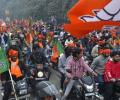
A report by the Association for Democratic Reforms (ADR) reveals that the BJP declared the highest income among national parties in FY 2024-25, while the Congress's income declined.

The total expenditure on the MGNREGA programme, as per the revised estimates from 2025-26, was Rs 88,000 crore, while initially, a sum of Rs 86,000 crore was allocated.

Of the 1.32 trillion capex target for FY26, State-run oil firms have already spent 1.07 trillion in the first 10 months.

The idea of back-loading the target of fiscal consolidation is perhaps guided by the government's desire to be prepared for any adverse developments in the coming year, points out A K Bhattacharya.

India's retail inflation, which has stayed below the Reserve Bank of India's (RBI's) 4 per cent target in recent times, is likely to remain benign in the coming months, RBI Deputy Governor Poonam Gupta said in a speech, on Friday, which was uploaded on the central bank's website on Tuesday. Headline inflation dipped to multi-year lows of around 1.5-2.8 per cent in late 2025.

A senior Maoist commander, Papa Rao, surrendered with his team in Chhattisgarh, signalling a significant blow to Left-Wing Extremism in the region. This event underscores the impact of sustained security pressure and rehabilitation efforts on the Maoist movement.

Tata Motors' commercial-vehicle (CV) business reported a 48 per cent year-on-year decline in net profit to Rs 705 crore in Q3FY26, even as profit before tax (PBT) rose 65 per cent to Rs 2,568 crore.

Of the donations, 48% is in kind -- such as food, clothing, or other household goods -- followed by cash (44%) and volunteering (30%) with non-profits, religious institutions, or community groups.

Stock market is gearing up for an eventful week ahead where key triggers such as quarterly earnings from corporates, the US Fed interest rate decision and the upcoming Union Budget for 2026-27 would grab the limelight, analysts said.

Supported by strong buoyancy in public sector capital expenditure (capex), growth in infrastructure investment is expected to accelerate in 2025-26 (FY26) compared to 2024-25 (FY25), according to the First Advance Estimates of gross domestic product (GDP) for FY26 released by the National Statistics Office (NSO) on Wednesday.

After the last Budget's announcement of a major tax relief for those earning an annual salary of less than Rs 12 lakh, there is not much that individuals can look forward to in the forthcoming Budget, points out A K Bhattacharya.

The committed expenditure recorded a 9.37 per cent increase, reaching Rs 15.64 trillion.

A neutral monetary policy stance, heavy government borrowing, and issuers adjusting to a higher-for-longer yield environment have set the stage for a largely stable corporate bond market in 2026.

This is the second-worst performance by the pack during this period over the last five years since CY20.

'The bigger unknown remains global geopolitics, which is inherently unpredictable, including developments in our neighbourhood.' 'Another concern is the increasing tilt of government finances towards welfare subsidies, especially at the state level.' 'This could constrain capital expenditure, which is critical for long-term growth.'
